Medical Writing
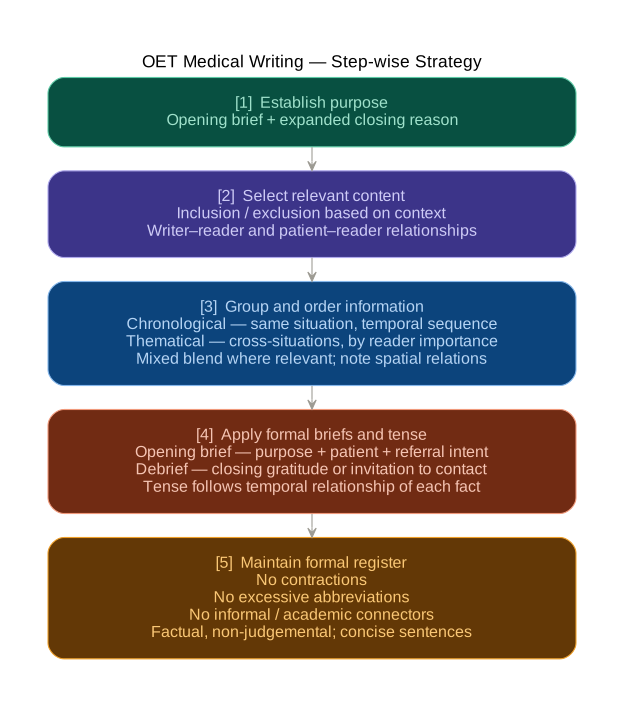
The following document demonstrates a flexible and robust strategy to tackle the OET medicine writing task sub-test in the form a step-wise strategy.
Establishing Purpose of the letter.
There are two components for establishing the purpose of the clincal letter:
-
Provide an immediately apparent purpose attached at the beginning of the letter.
-
Provide a sufficiently expanding purpose and reason attached at the end of the letter.
Choosing relevant content to be included based on the context
Choosing the relevant content is a one way to attract the reader or to lose them immediately; the writer-reader relationship, and the patient-reader relationship (i.e., Inclusion and Exclusion Critera).
-
Build an inclusion and an exclusion criteria by identifying the context, the writer-reader relationship, and the patient-reader relationship.
-
In addition, use the purpose of the letter and the reason to write the letter, in the first place, to better delineate the criteria parts.
Grouping information and ordering them
Grouping the information presented in the letter should be according to the formerly presented relationships; addressing both the chronological and the thematical ordering of the timeline, and demonstrating the temporal and the spatial relations, if exist, among the presented timeline.
-
Chronological ordering of the presented information.
-
Thematical ordering of the presented information.
-
Use a blend of both to address ordering of the timeline for the same situation (Chronological Ordering), and address temporal ordering of the other situations in general (Thematical Ordering).
-
Consider identifying the spatial relationships among different sitations, only if relevant.
|
Ordering Techniques in Clinical Writing
|
Identify the formal introductory briefs, their debriefs, and the tense of the content according to their temporal relationship.
Formal introductory briefs:
Thank you for seeing Mrs Anne, a 45-year-old female who presented with …., for your expert evaluation and advice.
I am referring to you Mrs Anne, …., for further evaluation and, if indicated, further investigations including endoscopic evalution.
I would be grateful if you could review Mrs Anne, ….., for further investigations and, if indicated, for endoscopic evaluation.
Avoid informal sentences and keywords taken from the academic world and poetry.
-
Avoid using contractions.
-
Avoid excessive abbreviations.
-
Avoid informal academic connectors.
-
Use factual writing and avoid judgemental writing style by presenting seemingly judicious materials as they are without paraphrasing.
-
Avoid long sentences.